
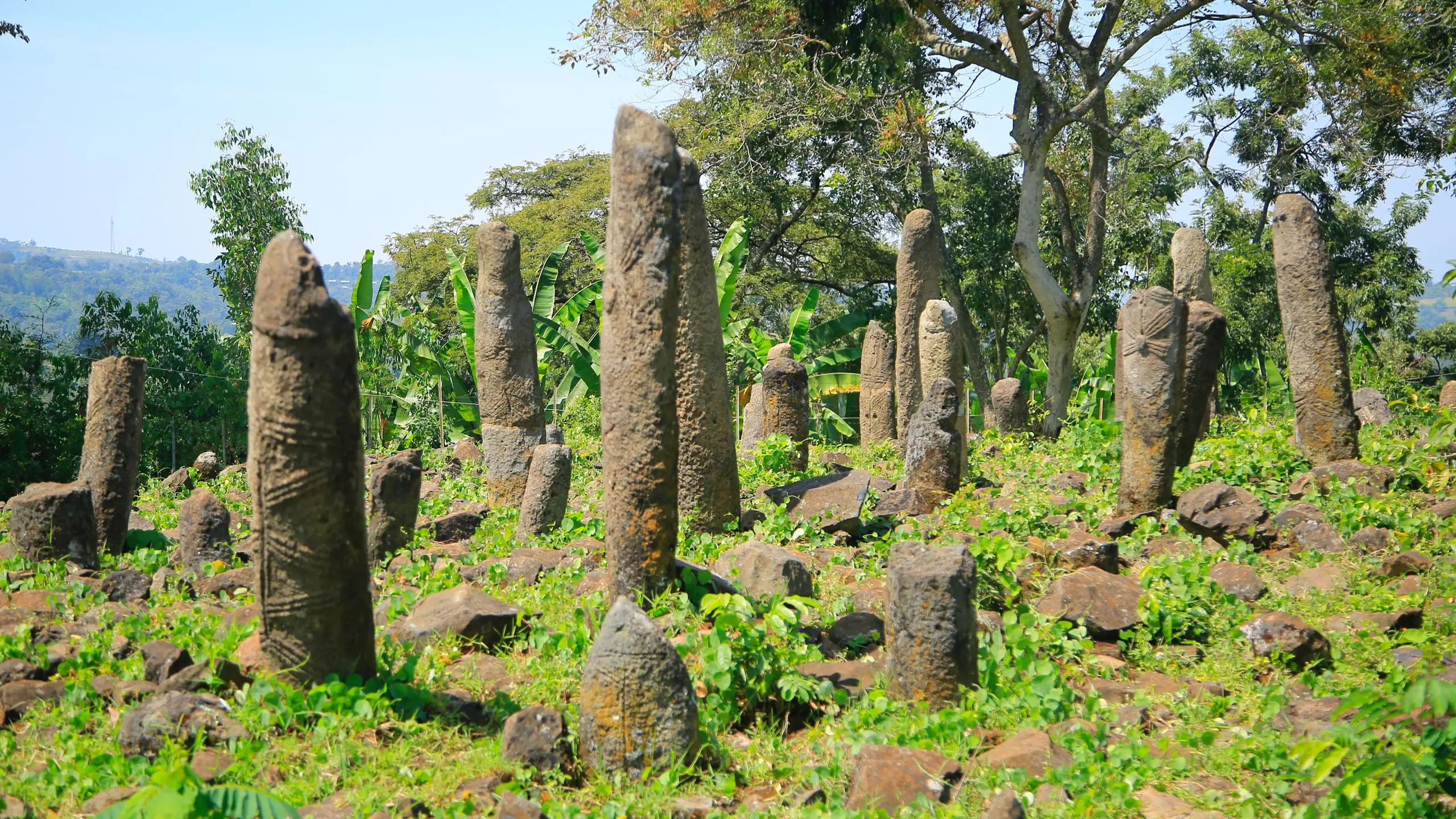
The Gedeo Zone:
The Gedeo Zone, located in the South Ethiopia Regional State, is bounded by the Sidama Region to the north and completely enveloped by the Oromia Regional State to the east, west, and south. It is the ancestral homeland of the Gedeo people. The region is globally distinguished by its unique, sustainable agroforestry system and its exceptional concentration of ancient megalithic stelae.
- Administrative Capital: Dilla serves as the primary administrative and economic hub of the zone. The zone is structurally divided into 8 weredas (districts) and 5 city administrations. Located 370 kilometers south of Addis Ababa, Dilla serves as the seat for the region’s economic cluster.
- Global Recognition: In 2023, the “Gedeo Cultural Landscape” was officially inscribed as a UNESCO World Heritage Site, celebrating the harmonious intersection of indigenous forest management and ancient archaeological marvels.
Part I: Archaeological and Tourist Attractions (Megalithic Stelae Fields)
Home to more than 6,000 megalithic pillars, the Gedeo Zone feature a wealth of cultural and historical sites, making it an extraordinary open-air laboratory for archaeologists, researchers, and travelers alike.
1. Major Stelae Fields
Chelba Tutiti Stelae Field
- Unique Features: This is the largest site in the region, hosting over 1,500 ancient, phallic-shaped standing stones weathered by centuries of time.
- Historical Significance: These monuments mark ancient burial grounds and serve as a testament to the early sociopolitical and egalitarian structures of the Gedeo people.
- Location: Situated in Chelba Kebele within the Yirgacheffe Wereda, approximately 25 kilometers from Dilla.
Tuto Fela Stelae Field
- Unique Features: This site is famous for its anthropomorphic carvings, where distinct human facial features and symbolic expressions are etched directly into the stone pillars.
- Historical Significance: The specialized artistry and iconography found here make it a primary destination for global researchers studying early African civilizations.
- Dimensions & Scope: It contains over 300 stelae ranging from 1 to 2.5 meters in height.
- Location: Found in Gemgemo Kebele within the Wanago Wereda, roughly 17.2 kilometers from Dilla.
Sede Mercato Stelae Field
- Unique Features: A dense concentration of over 470 standing monuments. This site is particularly unique because it showcases three distinct architectural styles of stelae in a single location: anthropomorphic (human faces), phallic, and geometric rectangular pillars.
- Historical Significance: Archaeological dating indicates these stones were erected between the late 1st millennium BCE and the early 1st millennium CE, representing a long, unbroken lineage of monumental tradition.
- Location: Located in Sede Kebele within the Yirgacheffe Wereda, 38 kilometers from Dilla.
Sakaro Sodo Stelae Field
- Unique Features: What sets this field apart is the sheer mass and monumental scale of its stones. The pillars feature an average thickness of 2.5 meters and tower up to 3.5 meters high.
- Historical Significance: It serves as a vital focal point for high-precision archaeological excavation and research.
- Scope: The site contains 43 massive standing stelae.
- Location: Situated in Halo Hartume Kebele within the Gedeb Wereda, about 76 kilometers from Dilla.
Basura Grave Site
- Unique Features: A deeply revered historical cemetery believed to be the final resting place of Derasho, the legendary foundational patriarch of the Gedeo clans.
- Historical Significance: Spanning 2 hectares, this site illustrates the profound reverence the Gedeo community holds for its ancestors and elders. It is highly valued by botanists and historians alike for its pristine, undisturbed flora.
- Location: Located in Basura Kebele within the Bule Wereda, 16 kilometers from Dilla.
2. Prehistoric Rock Art
Odola Galma Rock Art Site
- Unique Features: This prehistoric site features vivid rock engravings that are over 5,000 years old, capturing some of humanity’s earliest artistic expressions.
- Historical Significance: The engravings provide crucial evidence of early pastoralism, illustrating the ancient, deep-seated relationship between prehistoric human communities and livestock domestication. It stands as a rare chronicle of early civilization in the Horn of Africa.
Part II: Natural Attractions and Ecological Sanctuaries
1. Sacred Mountains and Reserves
- Mount Rako: Located in Kochere Wereda (Rako Kebele), 66 kilometers from Dilla, this imposing peak acts as a critical watershed and climate stabilizer for the surrounding coffee-growing regions. It offers excellent trails for eco-trekking.
- Mount Barcha: Situated 33 kilometers away in Bule Wereda, this mountain is a biological sanctuary rich in indigenous medicinal plants, endemic bird species, and diverse wildlife. It provides panoramic views of the layered, green Gedeo agroforestry canopies.
- Wogida Amba: Located in Yirgacheffe Wereda (Wogida Kebele), 48 kilometers from Dilla, this protected 15-hectare plateau is an ecological reserve packed with native old-growth trees, mammals, and birds.
2. Caves and Waterfalls
- Werera Cave: Tucked away in Wanago Wereda (Watiko Kebele), this natural cavern system historically served as a strategic sanctuary during wartime and secret, cool council chambers for community elders. Today, it is an intriguing destination for travelers seeking historical narratives.
- Bololosa Waterfall: A high, dramatic waterfall hidden in Rape Wereda (Rasa Dango Kebele), completely enclosed by dense, untouched indigenous forests. It is an ideal spot for nature photography and peaceful retreats.
- Sika Twin Waterfalls: Located 29 kilometers from Dilla in Bule Wereda (Sika Kebele), these spectacular, identical twin waterfalls cascade side-by-side from a height of over 100 meters, framed beautifully by lush, native vegetation.
- Malka Karaba Waterfall: Found just 29 kilometers from Dilla in the Bule City Administration (01 Kebele), this unique 15-meter waterfall is distinct because it plunges directly across an open, high-altitude grassland plain rather than a rocky mountain gorge.
Part III: Culture, Traditional Governance, and Economy
1. Indigenous Governance: The Baalle System
The social, judicial, and political life of the Gedeo people is governed by the Baalle System, an indigenous age-grade institutional framework similar to the Oromo Gadaa system.
- Power & Justice: The Baalle system oversees peaceful leadership transitions, traditional conflict resolution, and the scheduling of seasonal rituals.
- The Songo: The traditional open-air council ground where elders and cultural leaders gather to adjudicate disputes, ensure community justice, and make binding communal decisions.
- Sacred Clan Sanctuaries (Kar’o or Yaa’a): These are strictly protected, sacred old-growth forests designated for the spiritual rituals of the Abba Baalle (the supreme cultural leaders). Under strict customary law, unauthorized entry into these forests is completely forbidden without the explicit blessing of the elders.
2. Cultural Festivals and Cuisine
- Deraro Festival: The traditional Gedeo New Year and annual harvest thanksgiving celebration. Led by the Abba Baalle, it is a vibrant season marked by unity, traditional songs, and expressions of gratitude for the land’s bounty.
- Traditional Culinary Staples:
- Kocho: The undisputed cornerstone of Gedeo cuisine, made from the fermented, scraped pulp of the Enset (false banana) plant. It is baked on clay griddles into a dense, nutritious flatbread.
- Bula: A premium, smooth porridge or nutrient-dense gruel crafted from the refined starch extracted during enset processing.
- Dararo (Ritual Food): A culturally symbolic dish prepared from whole, unhulled coffee cherries cooked with wild honey and mixed with roasted barley (kolo).
3. Economy and Heritage Crafts
- Yirgacheffe Coffee: The economic backbone of the Gedeo Zone. Widely recognized as one of the finest organic Arabica coffees in the world, Yirgacheffe coffee is famous for its distinct floral, bright, and citrusy aroma. Its exceptional quality stems from the UNESCO-recognized agroforestry system, where coffee shrubs are grown sustainably under the shade of ancient forest canopies and enset plants.
- Handicrafts: The region boasts a strong tradition of artisans, specialized in:
- Bamboo Weaving: Creating structural items, storage containers, and household tools from local bamboo.
- Enset Fiber Crafts: Turning tough enset fibers into durable mats, sacks, and seating cushions.
- Traditional Pottery: Firing local clay into beautifully shaped cooking pots, coffee boiling jars (Gebena), and serving vessels.
Part IV: A Sample 4-Day Travel Itinerary
This optimized itinerary uses Dilla as a base to discover the unparalleled blend of archaeology, living culture, and world-class coffee that defines the Gedeo Heritage.
- Day 1: Arrival & The Megalithic Giants
Drive south from Addis Ababa through the Rift Valley to Dilla. After checking in, spend the afternoon exploring the sweeping Chelba Tutiti Stelae Field to witness the vast collection of phallic monuments.
- Day 2: Sacred History & Facial Carvings
In the morning, travel to Bule to visit the historic Basura Grave Site, the resting place of patriarch Derasho. In the afternoon, head to Tuto Fela to see the intricate anthropomorphic facial carvings. In the evening, arrange an introductory discussion with cultural experts or representatives of the Baalle system to learn about their indigenous governance.
- Day 3: Organic Coffee & Highland Peaks
Drive out to the historic town of Yirgacheffe. Tour a shaded, organic coffee cooperative to see Gedeo’s famous agroforestry system in action, followed by a traditional coffee ceremony. Spend the afternoon hiking up Mount Rako or enjoying the views from Wogida Amba.
- Day 4: Ancient Art & Return
Begin the morning by visiting the Odola Galma Rock Art Site to view the 5,000-year-old pastoralist engravings. Conclude your trip by browsing the vibrant local markets in Dilla or Yirgacheffe for organic honey, spices, and woven bamboo crafts before starting your return journey.