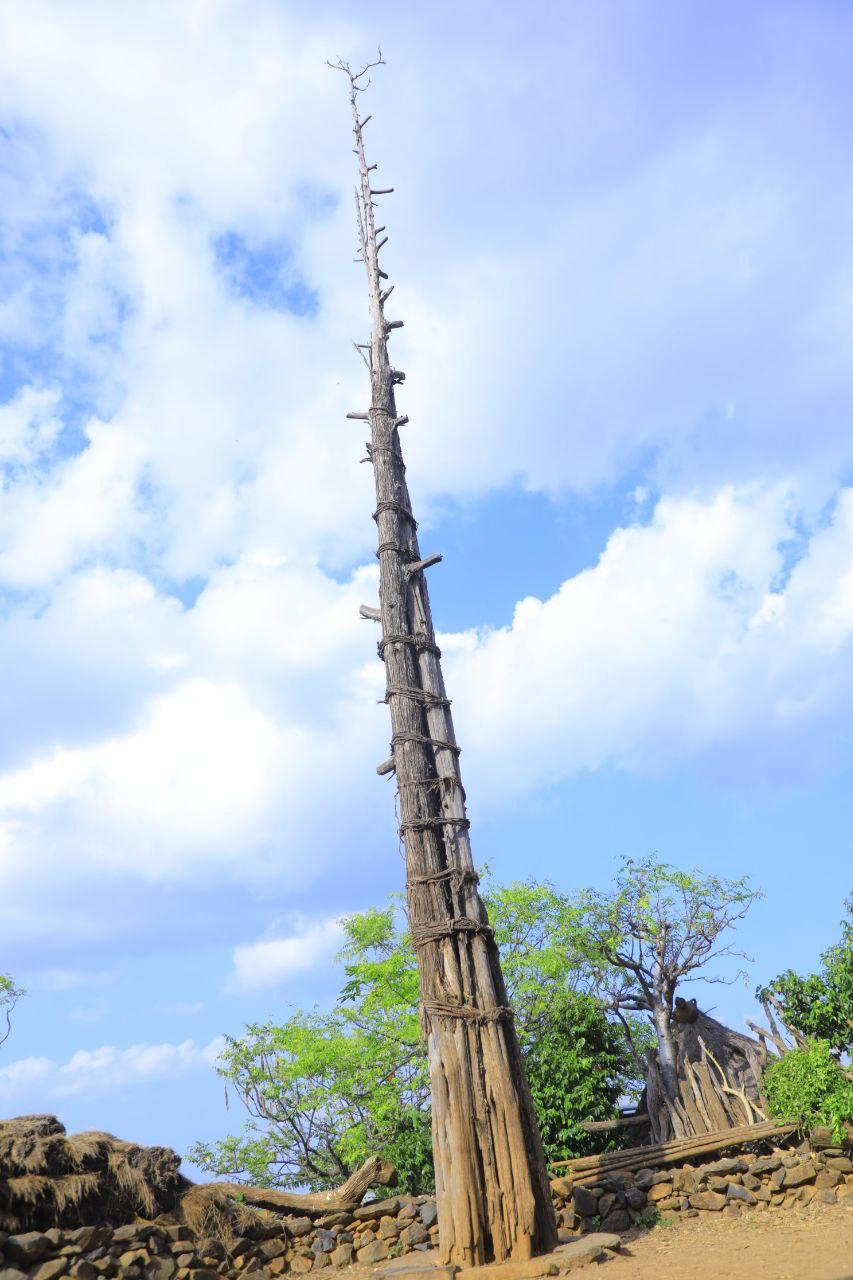
Detailed Explanation of Olahita (Generation Pole)
The Olahita is a tall ceremonial pole used by the Konso people to record the transition of generations and the passage of history. This pole serves as a living archive that clearly demonstrates the Konso people’s chronological system and their social governance structure (similar to the Gada system).
Detailed information about the Olahita is provided below:
1. Meaning and Essence
- Generation Marker: An Olahita is a tall wooden pole erected once every 18 years within a Konso village (Kanta).
- Symbol of Power Transition: The pole is raised during the transfer of power and responsibility from one generation to the next. This signals that the new generation has officially taken over the duty of ensuring the peace, security, and development of the village.
2. Design and Construction
- Physical Structure: The Olahita is made of two long wooden poles intertwined or tied together, standing at a significant height. This height symbolizes the wish for the new generation to be as strong and long-lived as the pole itself.
- Location: It is usually erected in the village center, in the open square directly in front of the Mora (the public gathering hall).
- Durability: The pole is crafted from “Dahara,” a type of exceptionally hard wood known for its resistance to rot and decay over many years.
3. Historical Calculation (Chronology)
The Olahita serves as a “calendar” to determine the age of a village:
- Mathematical Calculation: By simply counting the number of Olahita poles standing in front of a Mora, one can determine how many years have passed since the village was founded. For example, if there are 10 poles, the village is approximately $10 \times 18 = 180$ years old.
- Generational Succession: Each pole represents the era of a single generation.
4. Cultural Ceremony
The raising of an Olahita is not a simple task; it is accompanied by a major cultural festival:
- Celebration and Preparation: On the day the pole is erected, there is great joy and traditional dancing throughout the entire village.
- Symbolism: When the pole is raised, the leaders of the outgoing generation bless the new generation and entrust them with their duties. This encourages the youth to fulfill their social obligations.
5. Significance for Tourism
- Historical Testimony: Visitors to Konso villages can understand the antiquity and organized nature of the community simply by observing the Olahitas.
- Photography: Because of its unique shape and deep meaning, it is a highly attractive site for photographers and historical researchers.
Travel Itinerary: The Olayta (Generation Pole) Trail
This itinerary focuses on the ancient villages where the finest and most numerous Olayta poles are preserved.
Day 1: Karat City and Dokatu Village
- Morning: Arrive in Karat (Konso).
- Afternoon: Travel to Dokatu Village. This village is an excellent showcase of Konso’s traditional structure, featuring several Olayta poles standing together.
- Observation: Join your guide in counting the poles to calculate the historical age of the village.
- Evening: Overnight stay in Karat.
Day 2: The Ancient Village of Mecheke
- Morning: Travel to Mecheke Village. As one of the oldest UNESCO-registered villages, Mecheke houses Olayta poles with an exceptionally long history.
- Afternoon: Meet with village elders to listen to the history of the 18-year power transfer cycle (a system similar to the Gadaa system).
- Evening: Overnight stay at a lodge in Karat.
Day 3: Gamole Village and Departure
- Morning: Visit Gamole Village. Here, you will find another significant collection of Olayta poles alongside the famous stone defensive walls (Kaffa).
- Afternoon: Begin your return journey to your starting point (Arba Minch or Hawassa).

